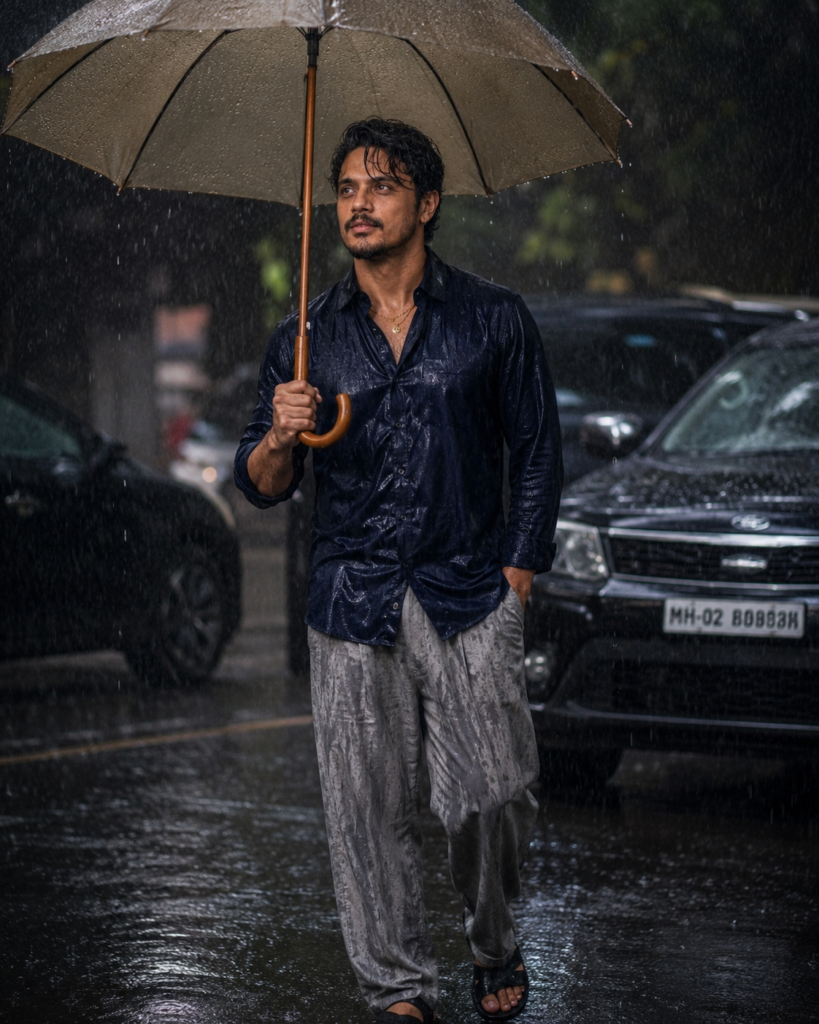
There is something timeless about rain. A quiet roadside during a heavy monsoon, blurred headlights in the background, soaked clothes, and a single umbrella shielding only part of the body—it’s a scene that instantly tells a story without saying a word.
With modern AI image generation, scenes like these are no longer limited to expensive photoshoots or professional film sets. By writing a detailed prompt and preserving facial identity accurately, you can create cinematic portraits that look as if they were captured by a professional photographer during a real rainstorm.
In this article, I’ll break down the creative concept behind this image, explain why every detail matters, and show how careful prompt engineering transforms a simple portrait into a movie-like masterpiece.
Why Cinematic Rain Portraits Are So Popular
Rain naturally adds emotion to an image.
Instead of feeling like a standard portrait, a rainy environment creates atmosphere. Water droplets, reflections on the road, soft background blur, and dramatic lighting all work together to make a photograph feel alive.
Unlike studio portraits, monsoon portraits tell a visual story.
The viewer begins asking questions.
- Where is this person going?
- Why are they standing in the rain?
- What are they thinking?
- Why are they looking into the distance?
Good cinematic photography makes people curious, and curiosity keeps viewers engaged.
The Importance of Identity Lock
One of the biggest challenges with AI-generated portraits is maintaining the exact facial identity.
Without proper instructions, AI models often change:
- Face shape
- Jawline
- Beard
- Hairstyle
- Eye shape
- Skin tone
- Facial proportions
Instead of creating the same person, the AI invents someone who merely resembles them.
That’s why the prompt begins with an extremely strict identity instruction.
It tells the model to preserve:
- Exact facial structure
- Jawline
- Cheekbones
- Nose
- Lips
- Eyes
- Eyebrows
- Beard style
- Hairline
- Hairstyle
- Skin texture
- Natural expression
This ensures the final image still looks like you instead of creating a completely different face.
For realistic portraits, identity preservation is often the single most important part of the prompt.
Building the Scene
Rather than describing only the subject, a good AI prompt describes an entire environment.
Imagine standing alone beside a quiet road during heavy monsoon rain.
Large drops continuously fall around you.
The asphalt is completely wet.
Street reflections shimmer underneath.
The background slowly disappears into soft cinematic blur.
Dark parked cars sit quietly behind you, adding realism without stealing attention.
Instead of looking directly into the camera, you’re gazing slightly upward toward your left.
That small adjustment completely changes the emotional impact.
The image now feels thoughtful rather than posed.
Clothing Matters More Than Most People Think
AI pays close attention to wardrobe.
In this portrait, the clothing choices intentionally create contrast.
The dark navy blue button-up shirt becomes soaked from continuous rain.
The wet fabric sticks naturally to the body, revealing realistic folds and texture.
The light gray loose-fit trousers create visual balance while also showing realistic water absorption near the lower legs.
Simple dark sandals complete the look without making the outfit appear overly fashionable.
Nothing feels exaggerated.
Everything looks practical.
This realism is what separates cinematic portraits from fantasy artwork.
The Umbrella Isn’t Just a Prop
One of the strongest storytelling elements is the beige umbrella with a wooden curved handle.
It serves several purposes.
First, it immediately becomes the visual anchor of the image.
Second, it creates contrast between the protected upper body and the rain-soaked clothing underneath.
Instead of shielding everything, the umbrella protects only part of the subject.
This creates realism because heavy monsoon rain rarely leaves anyone completely dry.
The wooden handle also adds warmth against the otherwise cool, rainy environment.
Small details like this often make the image feel expensive and professionally designed.
Camera Composition
Composition determines whether an image feels like a social media photo or a movie still.
This portrait uses several cinematic principles.
The subject stands slightly off-center.
The camera remains at eye level.
The background stays heavily blurred using shallow depth of field.
Rain creates multiple foreground layers.
Soft natural lighting wraps around the face.
Everything behind the subject fades into creamy bokeh.
This separation makes the viewer focus entirely on the person instead of the surroundings.
Professional photographers use this exact technique to isolate subjects in busy environments.
The Emotional Expression
Expression is often overlooked in AI prompts.
A smiling face would completely change the mood.
Instead, this portrait uses a calm, serious expression.
There is no forced emotion.
No dramatic sadness.
No exaggerated smile.
Just quiet confidence.
Looking slightly upward instead of directly into the camera creates the impression that the subject is thinking rather than posing.
Sometimes the smallest facial adjustments tell the strongest stories.
Why Background Blur Is Essential
Many AI images fail because the background becomes too detailed.
When every object is perfectly sharp, the eye doesn’t know where to focus.
In this portrait, blurred black parked cars provide context without distraction.
The viewer understands the location instantly.
A roadside.
A rainy day.
Urban surroundings.
Nothing more needs to be explained.
The soft blur keeps attention exactly where it belongs—on the subject.
Realism Through Small Details
Hyper-realistic AI images aren’t created by adding more objects.
They’re created by adding believable details.
Examples include:
- Rain droplets on clothing
- Wet hair sticking naturally to the forehead
- Water reflections on the road
- Damp fabric texture
- Natural skin texture
- Soft cinematic lighting
- Slight facial imperfections
- Realistic beard growth
- Gentle background blur
- Rain particles catching the light
Each detail may seem insignificant on its own.
Together, they convince the viewer that the photograph is real.
The Role of Lighting
Lighting determines the mood more than any other element.
This portrait avoids harsh sunlight.
Instead, it uses soft overcast monsoon lighting.
The face receives gentle illumination while maintaining realistic shadows.
Rain diffuses the available light naturally, producing smooth transitions across the skin.
This soft contrast creates the polished look often seen in premium fashion editorials and cinematic photography.
Prompt Engineering Makes the Difference
The biggest misconception about AI art is that better software automatically creates better images.
In reality, better prompts produce better results.
A detailed prompt guides the AI through every creative decision:
- Identity
- Pose
- Camera angle
- Lighting
- Clothing
- Environment
- Weather
- Background
- Mood
- Expression
- Color palette
- Depth of field
- Realism
Every additional instruction removes ambiguity.
Instead of letting the AI guess, you tell it exactly what to create.
That precision is what transforms ordinary AI outputs into professional-quality portraits.
Final Thoughts
This cinematic monsoon portrait demonstrates how thoughtful prompt writing can recreate the feeling of a high-end editorial photoshoot without stepping into a studio. By combining strict facial identity preservation, realistic environmental details, balanced composition, natural clothing textures, and atmospheric rain, the result feels authentic rather than artificially generated.
The beauty of AI image generation lies in its ability to turn vivid imagination into photorealistic visuals. Whether you’re creating content for your portfolio, social media, or personal projects, success comes from describing not just what you want to see, but how you want the viewer to feel. Every element—from the rain-soaked shirt and beige umbrella to the blurred roadside and contemplative gaze—works together to tell a compelling visual story.
As AI models continue to improve, mastering prompt engineering will become just as valuable as mastering photography itself. The more intentional your prompts, the more cinematic, believable, and emotionally engaging your creations will become. In the end, great AI art isn’t just about generating beautiful images—it’s about crafting moments that feel real enough to make viewers stop, look, and wonder about the story behind the frame.